Hitting the founder wall
Between $1M and $5M isn't a product problem, isn’t a market problem, isn’t even really a sales problem. It's a playbook problem. It's that you've never built the playbook that sells without you.
Every founder knows the feeling of the first breakthrough. The first yes. The first six figures. Maybe the first million. Somewhere in there, a quiet story starts forming in your head: "This can really sell!"
And then the wall.
Most founders hit it between $1M and $5M. Deals that used to close in two calls suddenly sprawl across five stakeholders and three months. Proposals get "circulated." Champions go quiet. Your conversion rate slips.
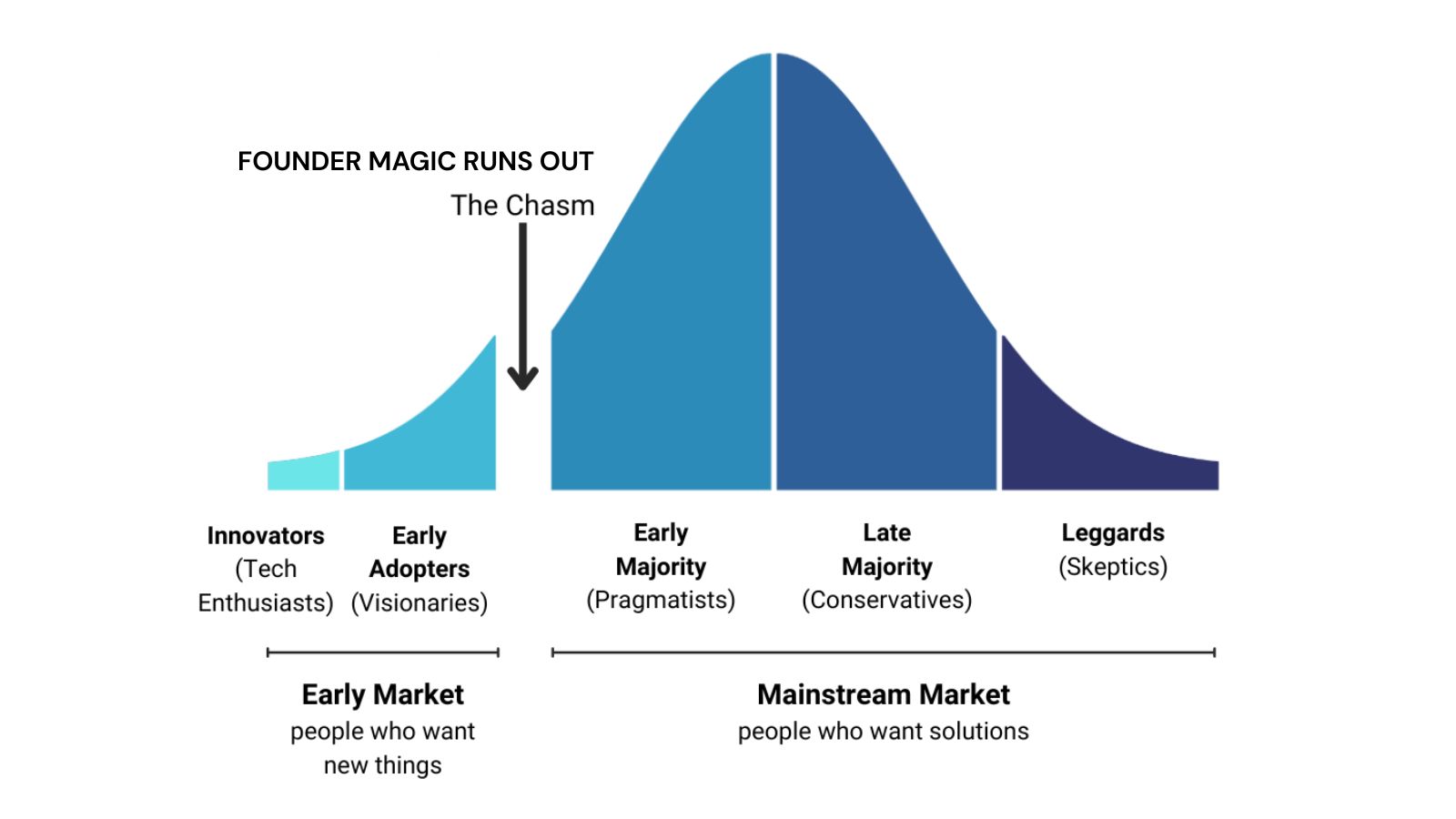
The temptation is to blame the product, the reps, the market, the pricing, or the fact that "enterprise is just slower." The actual answer is less flattering and more fixable: the thing closing deals for the first three years was never fully the product. It was largely you and a specific kind of buyer willing to bet on you. Known as the innovators and early adopters, they were the customers willing to give you a shot.
That's founder magic. And founder magic does not scale.
That combination has a shelf life. Once you exhaust the buyers who were already predisposed to say yes, the next tier of customer shows up with a committee, a procurement process, and a very different question in their head: not "do I believe in this founder?" but "can I defend this purchase to my boss?"
That's where founder magic runs out.
What founder magic is
Most founders believe the magic is charisma, the perfect pitch, or the product. Strip it to its components and it's four things stacked on top of each other:
Deep domain expertise
You didn't start the company on a hunch. Most founders bring a decade or two of professional experience in the problem space, often paired with serious education, patents, operating scars, or a career that made starting this company the obvious next move. When a prospect pushes back, you're not reciting a trained talking point. You're responding from earned expertise that predates the company itself. That kind of credibility is extraordinarily hard to fake and nearly impossible to hire.
Ownership authority
You own the company. That means you don't need to check with anyone. You can authorize a custom feature, break a rule, make an exception, rewrite a contract term, or fix a problem personally. Customers know that when a founder gives their word on an outcome, the founder has the actual power to guarantee it. That guarantee shows up in the buyer's risk calculation as real dollars and it's a promise no employee, no matter how senior, can make the same way.
Conviction
This is the social-emotional belief that only an owner demonstrates. You built this because you believed, and that belief shows up in every sentence, every objection handle, every follow-up. Buyers can feel the difference between a founder who believes and a rep who's on quota. Conviction rarely closes the deal by itself but when stacked with expertise and ownership, that belief is believable.
Pricing flexibility
This is the one most founders don't want to admit out loud. In the early years, you had room to move on price. Your overhead was low, your pricing was still being tested, and you badly needed the logos, testimonials, and case studies that turn into social proof. So you cut deals. You threw in the extra module. You discounted to win. That flexibility was a closing tool and it worked because you alone had the authority and the economic runway to use it. The problem is that none of it lasts. As margin compresses, the team grows, and the burn math tightens, the same deals you used to close with price gymnastics are the deals that now stall. You run out of pricing flexibility long before you run out of prospects.
Those four things are a near-cheat code in early sales. Buyers can feel it. It's why founder-led companies close at rates that are measurably higher than hired-sales-led peers in the first couple of years.
Here's the part nobody warns you about: those four things are non-repeatable for a sales rep. You cannot hire equal deep domain expertise that's been earned by building the product. You cannot hire positional executive authority. You cannot hire founder conviction.
What works for the founder does not work for the front-line.
The trust-deficit in sales
Every B2B purchase, no matter how small, is governed by the same uncomfortable question the buyer is asking silently: Will this actually do what they're saying it will and will it solve my problem?
That question isn't cynical. It's rational. And the data on how buyers answer it should shake every founder who thinks the product sells itself:
- 69% of B2B buyers report finding inconsistencies between what a seller says and what the company's own website says, actively killing trust. (Gartner 2024 sales survey)
- 61% of B2B buyers now prefer a rep-free buying experience where possible, precisely because they've decided they can trust their own research more than the person selling to them. (Gartner press release)
- The average B2B buying committee has grown to somewhere between 8 and 13 stakeholders, arguably adding stronger vetting and de-risking to purchasing. (Forrester State of Business Buying 2024)
- 40% to 60% of B2B deals end in "no decision" not lost to a competitor, lost to the buyer doing nothing. (HBR by Dixon and McKenna)
- Of those stalled deals, Harvard Business Review's research on the JOLT Effect found that 56% are driven by buyer indecision (fear of messing up), not by a preference for the status quo. (HBR by Dixon and McKenna)
- 59% of software buyers regret at least one purchase they made in the last 18 months. (Gartner Digital Markets research)
Read those numbers again and notice what they're actually describing. Buyers don't believe sellers. Buyers don't trust committees to agree. Buyers are terrified of regret. Buyers would rather do nothing than do something that exposes their judgment.
That is the trust deficit. It isn't a vibe. It's the default state of every B2B purchase in 2026.
When you, the founder, are on the call, you collapse that deficit with your own presence. Your expertise neutralizes the "they don't know my world" objection. Your authority neutralizes the "they'll over-promise and leave me to fight for implementation" objection. Your conviction neutralizes the "they just want a sale" objection. And your price breaks drops the perceived risk.
Why the buyer's are so unforgiving
Decision-science literature is remarkably clear: when a decision-maker expects to be evaluated on the outcome, they become more risk-averse, not more analytical. They choose the option that minimizes blame exposure, even when it's not the best option for the business. Researchers call it "defensive decision-making.”
Your early buyers (innovators, early adopters, fellow believers) weren't doing this math as strongly and likely had a price point that de-risked the purchase.
As you scale into the majority, the buyers you're selling to are completely different. They have a boss. They have a committee. They have a career. If your thing fails, they hold the blame.
This is the environment your sales reps are selling into. Without a system for closing trust deficits, they are walking into a room where the buyer has a problem to solve but embraces high skepticism towards any product to solve it.
The six trust gates
At Quotient Lab, we frame every B2B deal as a Change Journey with six variables. Every deal, won or lost, is governed by them:
- Is the buyer's problem clear, solvable, and a priority?
- Is the value justified compared to the cost?
- Do both parties trust the solution is correct?
- Are both parties comfortable with the risk?
- Are the stakeholders correctly aligned?
- Did the sales discipline happen to make sure all of that is true?
The transition from founder-led to team-led revenue is not about hiring “better closers.” It's about building a system that addresses this list that anyone can run. Without this playbook & system, your reps are running the product-led motion most sales orgs default to: qualification, demo, proposal, price. The close rate on that motion, across industries, lands around 9%.
Nine percent. That's what happens when trust and change management are left to chance.
Overcoming trust-deficits begins with customer obsession
There are three moves that matter more than the rest.
First, know the problems your ICP experiences that your product fixes. The buyer does not need another feature tour; they need evidence that you understand their world better than they do. Diagnosis is differentiation. The goal of the first meeting is not "show the product." It is to clearly understand the problem the product needs to resolve. Step one is problem clarity.
Second, build your trust infrastructure on purpose. The trust you built one call at a time has to now live in durable artifacts: a diagnostic the buyer agrees with; a point-of-view doc that makes your reasoning legible and evidence-backed; a quantified business case template; an implementation plan that has transparency on who, what, when, and how the change is managed.
Third, name the risk before the buyer does. Since 40-60% of lost B2B deals die to indecision, not to competitors, the single highest change a sales team can make is to stop pretending the buyer isn't scared and stop pretending the deal is risk-free. Name the implementation risk. Name potential issues. Name the resources the buyer will need to involve internally. Every named risk is a trust deposit; every unnamed risk is a reason the deal will stall on the way to the committee.
The hard but worthy task
Breaking through the founder ceiling requires a new system, a new approach, and a new plan for the majority of buyers. The payoff is a company that closes without you on every call, a forecast that means something, and revenue that finally scales at the rate of the market instead of the rate of your calendar.
If this hits close to home, let's have a chat.
Sources:
Ready to transform your sales team?
Discover how Quotient Lab can help you identify strengths, close skill gaps, and build a high-performing sales organization.